
There is almost nothing as iconic as the Mid-Century Gas station. Once placed obviously along the road to attract weary travelers and to feed the gas to move along the road, now quite a few of the most wonderful architecturally stand empty and deserted.

This particular gas station in my area got me thinking about preservation of these great structures! This former Phillips 66 gas station, displays the quintessential stylized box design. Its space age canopy is visible as you approach far down the road
This fantastic and in-depth article from the National Park service, “The Preservation and Reuse of Historic Gas Stations” gives an amazing amount of detail about preserving these structures and the various historic styles.
Gas stations can architecturally be identified by several types, including:
- Shed type – these were detached structures built specifically for the sale of gasoline which appeared during the second decade of the twentieth century to perform demand generated by the Ford Model T and the growing affordable auto market. Often located in central business districts.
- Multiple use – it was common in rural areas to see gas stations appended to existing structures. Businesses such as restaurants, inns, repair garages, oil depots, and general stores with gas pumps out front were an extension of the original urban curbside gas stands.
- House type – in response to the growing number of these building in neighborhoods, the industry adopted conventional forms to make their stations look less like shacks and more like houses. These were more substation structures, with larger customer areas, and increasingly providing public bathrooms and service bays for car maintenance and repair.
-

ROUNDTOP FILLING STATION, SHERWOOD, PULASKI COUNTY – http://www.arkansaspreservation.com Programmatic stations – these fun buildings assumed many fanciful shapes, including: animals, apples, tea kettles, tepees, windmills, castles, icebergs, and airplanes. These became fun stops along routes and attracted people to stop, these programmatic stations were inspired by area culture, local interests, or the owners interests.
- Box-type stations – sporting Art Moderne and International Style motifs, box stations featured flat-roofs and unadorned exteriors of stucco, terra cotta, porcelain enamel steel, or structural glass panels. Most had glossy white exteriors and carefully designed lighting schemes to attract the attention of passers by.
- Stylized Box stations – to further distinguish themselves from the competition, owners and companies began to vary this basic form and also retrofit current shops with modern design forms. Display windows were often canted at an angle reminiscent of the tail fins sported by rockets and new automobiles. New canopies featured raking profiles, folded plate roofs, and boomerang-shaped supports reflecting a popular interest in aeronautics and high technology.
Re-purposing these various old stations has become the wave of the future. With new stations replacing the stylish old ones, people have hesitated to tear them down and so have found new uses for the structures.
Successful rehabilitation projects have converted historic stations for use as restaurants, cafes, bakeries, medical supply stores, antique shops, visitor centers, and offices for local business organizations and non-profit groups.
Service bays have been converted to art galleries, photo studios, seating areas for restaurants, and open office space. Some stations have even been rehabilitated for residential use. – The Preservation and Reuse of Historic Gas Stations
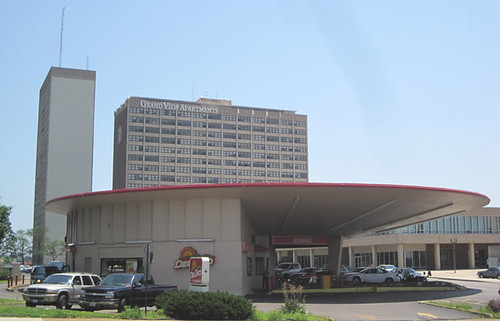
‘The Flying Saucer’ Phillips 66 Gas Station in St. Louis was a preservation and reuse success story. Built in 1967, when local preservationists found out this former gas station was threatened with demolition, they launched a public campaign to save the landmark. This glass and concrete building features a 120-foot circular roof and is a “prized example of mid-century modern architecture”. This saucer-shaped structure is now a Starbucks and is listed on the National Register of Historic Places.


